User Guide
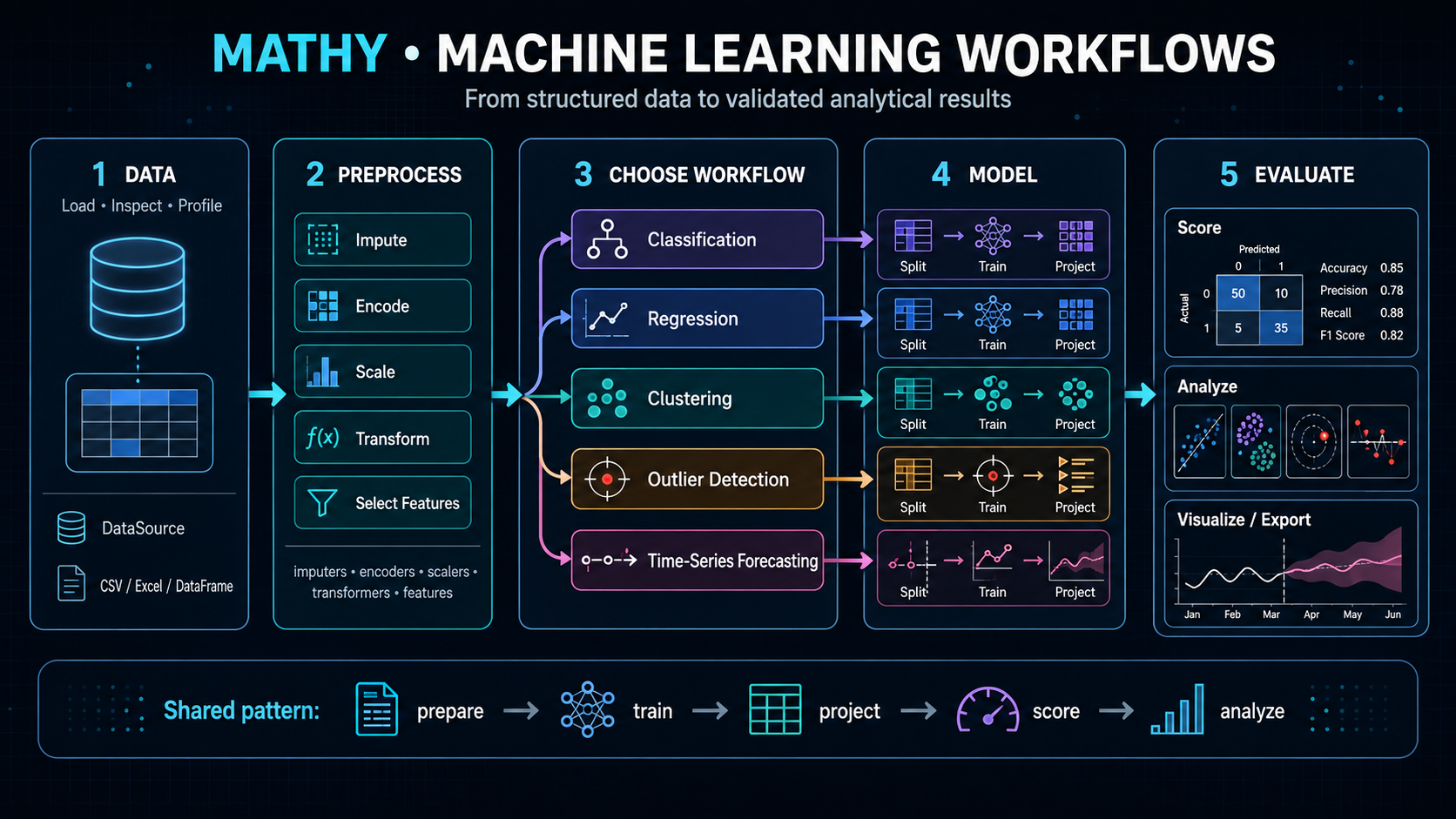
The Mathy user guide provides task-oriented examples for preparing data, transforming features, selecting predictors, training models, detecting outliers, clustering observations, and building time-series forecasts.
Use this guide when you want to understand how Mathy modules work together in practical workflows. Use the API reference when you need class-level, method-level, argument, return, or exception details generated directly from the Python source code.
🧭 Guide Overview
Mathy is organized around the major stages of a statistical modeling and machine learning workflow:
| Stage | Documentation Page | Purpose |
|---|---|---|
| Data Preparation | Data Preparation | Load dataframe inputs, create a DataSource, inspect columns, split data, scale values, encode labels, impute missing values, and transform feature matrices. |
| Feature Engineering | Feature Engineering | Select features, reduce dimensionality, rank predictors, apply recursive elimination, and prepare model-ready feature sets. |
| Modeling | Modeling | Train regression, classification, clustering, and outlier-detection models using Mathy wrappers. |
| Forecasting | Forecasting | Build time-series splits, lagged features, ARIMA models, SARIMA models, and lag-based forecasting workflows. |
🧱 Typical Workflow
A typical Mathy workflow starts with a pandas dataframe and moves through preparation, transformation, modeling, and output review.
import pandas as pd
from data import DataSource

df = pd.read_csv("data.csv")

source = DataSource(
    df=df,
    target="target_column",
    size=0.25,
    rando=42
)
After creating a DataSource, the workflow can branch into preprocessing, feature engineering,
model training, or forecasting.
DataFrame
   |
   v
DataSource
   |
   +--> scaling
   +--> encoding
   +--> imputation
   +--> transformation
   |
   v
Feature selection or dimensionality reduction
   |
   v
Regression, classification, clustering, outlier detection, or forecasting
🗃️ Data Preparation
The data preparation workflow centers on the DataSource class in data.py.
DataSource provides:
| Capability | Description |
|---|---|
| Working dataframe | Stores a copy of the source dataframe. |
| Target tracking | Stores the selected target column and target values. |
| Feature tracking | Derives non-target feature columns. |
| Column typing | Detects numeric and categorical columns. |
| Summary statistics | Computes descriptive statistics for numeric columns. |
| Splitting | Creates train/test splits using the selected test size and random seed. |
| Plotting | Supports histogram and heatmap generation. |
| Pivoting | Supports pivot-table creation for grouped analysis. |
🧪 Preprocessing
Mathy preprocessing modules prepare feature matrices before modeling.
| Module | Main Classes | Purpose |
|---|---|---|
scalers.py |
StandardScaler, MinMaxScaler, RobustScaler, NormalScaler, MaxAbsScaler |
Scale numeric features. |
encoders.py |
LabelEncoder, OrdinalEncoder, OneHotEncoder, TargetEncoder, PolynomialFeatures |
Encode categorical values and expand features. |
imputers.py |
MeanImputer, NearestImputer, IterativeImputer, SimpleImputer |
Replace missing values. |
transformers.py |
Binarizer, LabelBinarizer, TfidfVectorizer, CountVectorizer, DictVectorizer, FeatureHasher |
Transform numeric, categorical, text, dictionary, and sparse inputs. |
🧬 Feature Engineering
Feature engineering is handled through features.py.
Use feature engineering when you need to:
| Task | Example Classes |
|---|---|
| Remove low-variance predictors | VarianceThreshold |
| Reduce dimensionality | PCA, CCA |
| Select top predictors | SelectBest, SelectPercent |
| Apply sequential selection | SBS |
| Apply recursive elimination | RFE |
🤖 Modeling
Mathy separates modeling workflows by analytical purpose.
| Modeling Type | Module | Output |
|---|---|---|
| Regression | regressions.py |
Continuous predictions and regression scores. |
| Classification | classifications.py |
Class predictions, probabilities, labels, and classification scores. |
| Clustering | clusters.py |
Cluster assignments and clustering diagnostics. |
| Outlier Detection | outliers.py |
Outlier labels, anomaly scores, or fitted detection models. |
📈 Forecasting
Forecasting workflows are handled in forecasting.py.
Use forecasting classes when observations are ordered by time and model validation must respect that order.
Common forecasting tasks include:
| Task | Purpose |
|---|---|
| Time-series splitting | Preserve temporal ordering during model validation. |
| Expanding-window validation | Grow the training window across successive splits. |
| Lagged feature construction | Create predictor columns from prior observations. |
| Lag-based modeling | Fit supervised models against lagged time-series inputs. |
| ARIMA/SARIMA modeling | Fit statistical forecasting models for trend, autoregression, and seasonality. |
🧯 Error Handling
Mathy source modules use a consistent wrapped exception pattern with boogr.Error and
boogr.Logger.
The pattern records:
| Field | Purpose |
|---|---|
module |
Identifies the source package or module family. |
cause |
Identifies the class or function context. |
method |
Stores a stable method signature. |
| logged exception | Writes the wrapped exception before re-raising it. |
For methods with multiple parameters, the logged method string uses a compact *args signature.
This prevents logs from storing live values, dataframe contents, file paths, user data, or runtime-specific inputs.
📚 API Reference
The API reference is generated from the source code with MkDocs and mkdocstrings.
Use the API reference when you need:
| Detail | Source |
|---|---|
| Module documentation | Module-level Google-style docstrings. |
| Class documentation | Class docstrings and attributes. |
| Method signatures | Python function signatures and type annotations. |
| Arguments | Google-style Args: sections. |
| Return values | Google-style Returns: sections. |
| Raised exceptions | Google-style Raises: sections. |
| Source links | MkDocs source rendering where enabled. |