Home
Fonky is a Python library that exposes retrieval, loading, scraping, document-processing, and text-processing functionality to AI agents through provider-specific tool integrations.
Purpose
Fonky separates canonical implementations from agent-framework integration. Retrieval, loading, scraping, and processing logic remains in shared modules while provider packages expose those operations through the conventions required by OpenAI Agents SDK, Anthropic Claude, Google ADK, xAI, Mistral AI, and LangChain.
Core capabilities
| Area | Module | Purpose |
|---|---|---|
| Retrieval | fonky.fetchers |
Retrieve data from APIs, search services, public data sources, geospatial services, environmental services, and web sources. |
| Loading | fonky.loaders |
Load documents, files, cloud objects, mail, notebooks, and structured data. |
| Web extraction | fonky.scrapers |
Extract structured and unstructured content from web pages and crawled sources. |
| Processing | fonky.processors |
Normalize, clean, tokenize, transform, chunk, vectorize, and search text and datasets. |
| Models | fonky.models |
Shared models and response structures used by canonical implementations. |
| Configuration | fonky.config |
Runtime configuration, credentials, and defaults. |
| Error handling | fonky.boogr |
Shared error wrapping and logging. |
Provider integrations
| Package | Framework | Tool exposure |
|---|---|---|
fonky.gpt.tools |
OpenAI Agents SDK | @function_tool |
fonky.claude.tools |
Anthropic Claude SDK | @beta_tool |
fonky.gemini.tools |
Google ADK | Plain Python callables wrapped by ADK |
fonky.grok.tools |
xAI SDK | Executable callables plus explicit *_tool declarations |
fonky.mistral.tools |
Mistral AI SDK | Executable callables plus JSON *_tool declarations |
fonky.langchain.tools |
LangChain Core | @tool(parse_docstring=True) |
The architecture and workflow diagrams identify Claude and Mistral separately because they use different declaration objects and tool-result messages even though both execute Fonky callables locally.
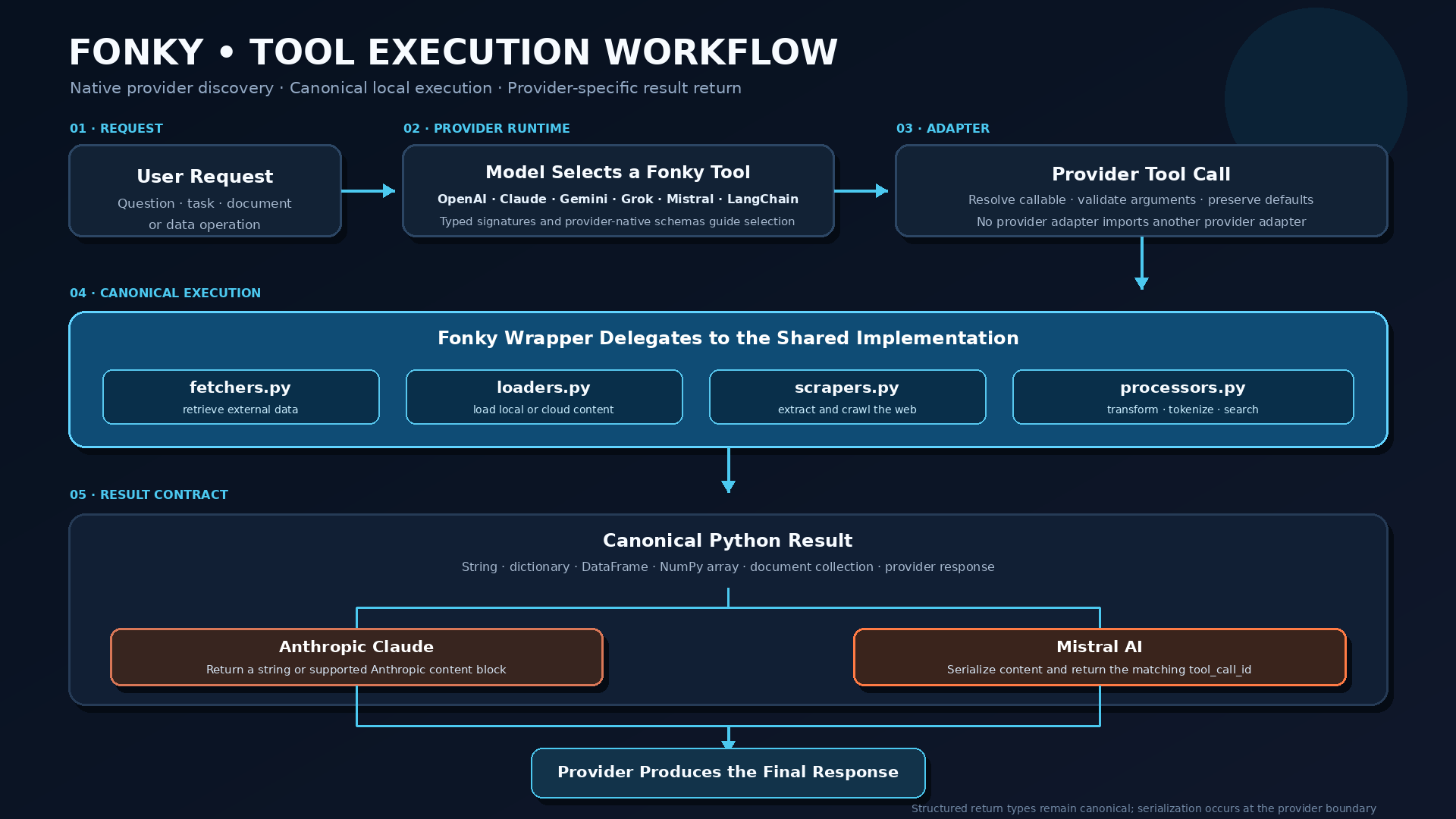
Each provider package exposes the same logical Fonky operations while preserving the provider-specific tool contract. Every provider integration is a peer adapter that delegates directly to the canonical to the canonical Fonky implementation modules rather than depending on another provider package.
Documentation layout
- Architecture defines canonical modules, provider adapters, naming rules, and execution flow.
- User Guide provides task-oriented examples for selecting and using Fonky tools.
- API Reference renders source documentation with MkDocs and mkdocstrings.
- Development defines validation, documentation, and extension requirements.
Build the documentation
python -m pip install -r requirements.txt
python -m pip install mkdocs-material mkdocstrings[python]
mkdocs serve
Build the static site: