Architecture
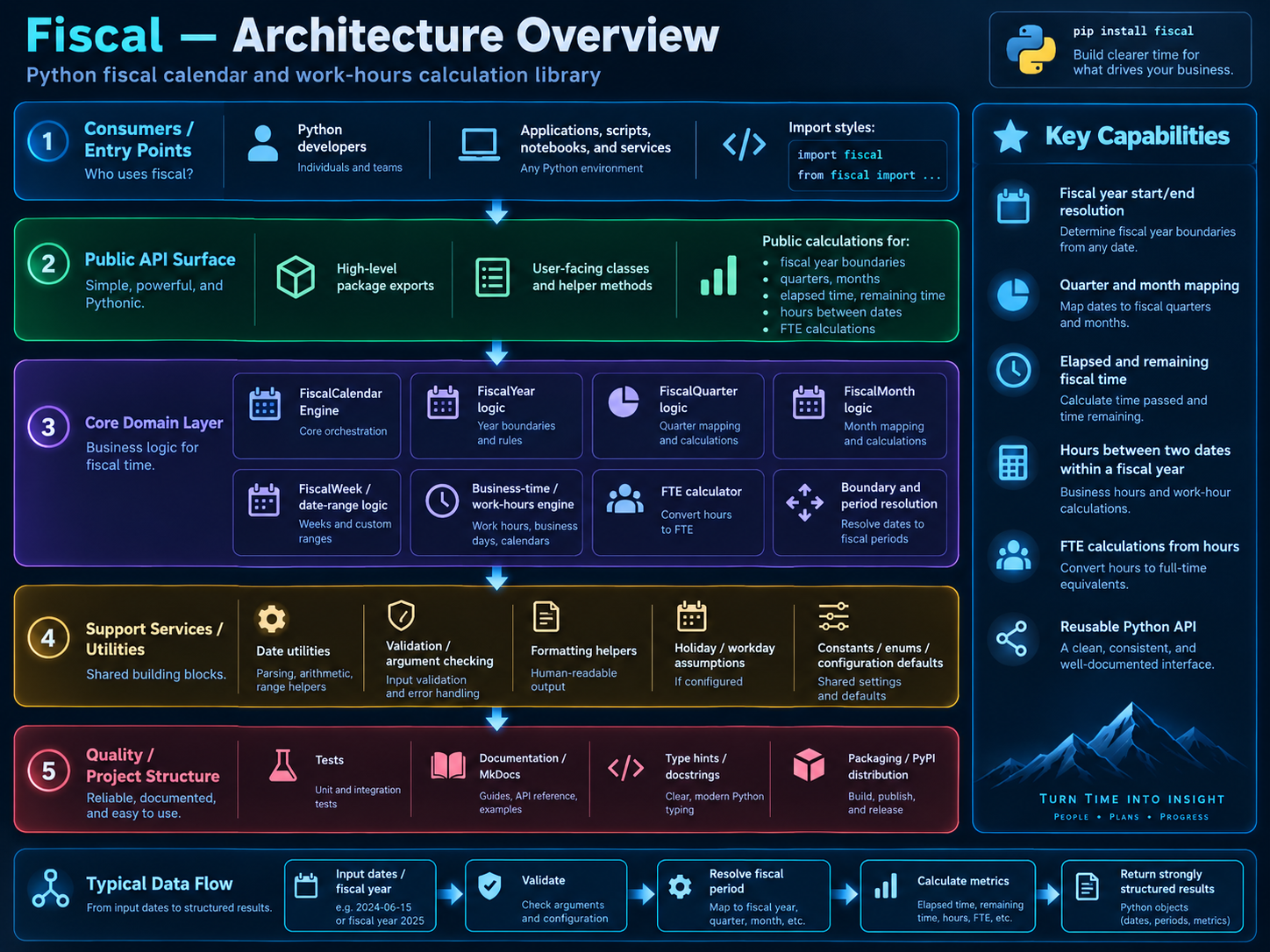
Overview
Fiscal is organized around four public domain and data-access classes:
DB: SQLite connection and query behaviorFiscalYear: fiscal-year records and calculationsFederalHoliday: federal-holiday records and observed-date behaviorFullTimeEquivalent: OMB regular and pay-period civilian FTE calculations
Text and HTML calendar methods remain integrated directly into FiscalYear. Shared argument and
date-normalization helpers live in fiscal.utilities, while the FTE model is isolated in
fiscal.fte because it has no database dependency.
Data Flow
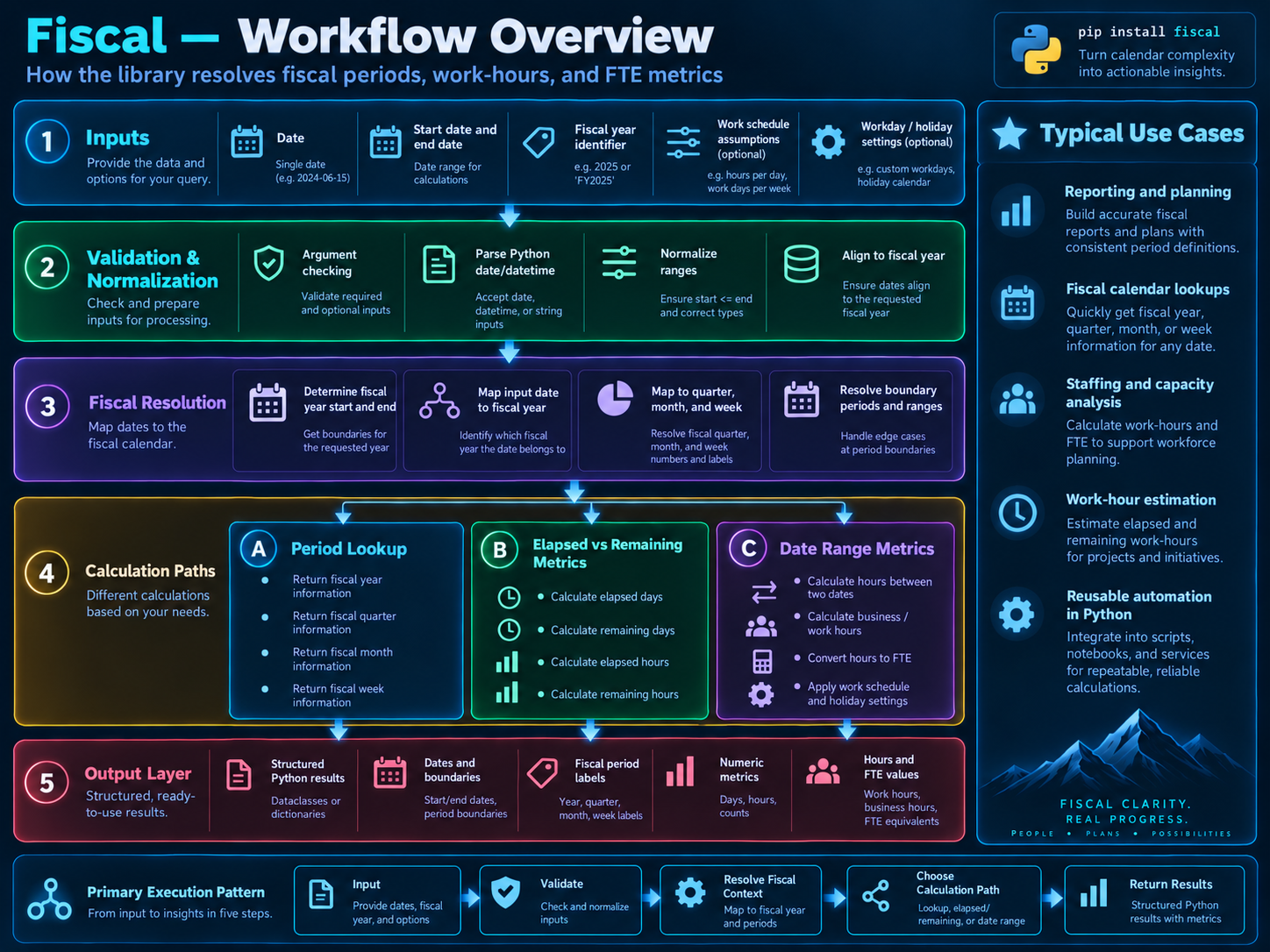
| Component | Input | Responsibility |
|---|---|---|
DB |
config.DB_PATH and config.TABLES |
Parameterized SQLite access |
FiscalYear |
BudgetFiscalYears row |
Period, range, hour, FTE, workday, and calendar calculations |
FederalHoliday |
FederalHolidays row |
Actual and observed holiday behavior |
FullTimeEquivalent |
Fiscal year and qualifying hours | OMB-compliant civilian FTE arithmetic |
Configuration
config.py supplies:
The expected table order is:
BudgetFiscalYearsFederalHolidays
Fiscal-Year Entity
FiscalYear hydrates one database row and derives:
- calendar and fiscal progress
- fiscal month, quarter, and week boundaries
- weekday, weekend, holiday, and workday collections
- date-range day, hour, and annual FTE calculations
- elapsed and remaining compensable-hour and work-hour calculations
- holiday mappings
- text and HTML calendars for months, fiscal years, and date ranges
Federal-Holiday Entity
FederalHoliday loads actual holiday dates and calculates observed dates:
- Saturday holidays are observed on Friday
- Sunday holidays are observed on Monday
- weekday holidays are unchanged
Error Handling
Operational methods wrap exceptions with the bundled fiscal.boogr.Error, including module, cause,
and method metadata. This preserves the original exception as the underlying cause while presenting a
consistent package-level error contract.